
By Tatiana Pentes
A novella
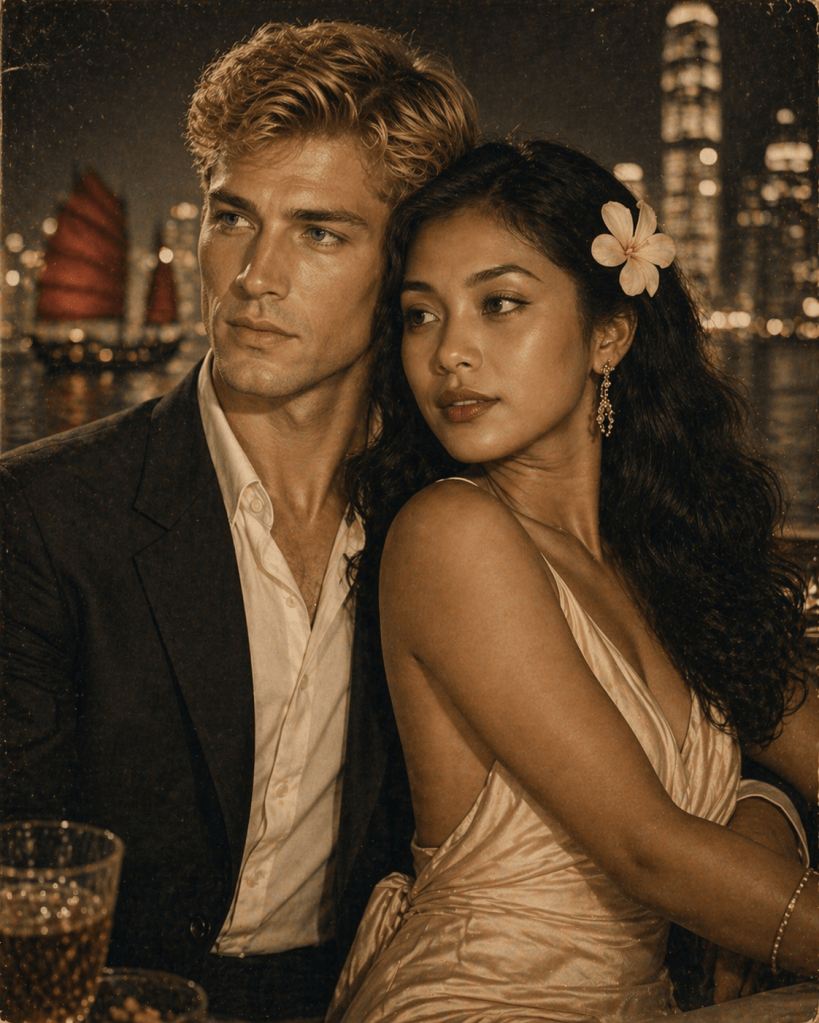
I. The Mirror Learns Her Name
Long before she knew men, Natalya knew absence.
She was six years old when her mother left her in the care of her Russian grandparents and disappeared toward the sea with a handsome foreign doctor whose vowels sounded expensive. Her father had already gone north with a travelling jazz band, carrying shirts in a valise and promises in no luggage at all.
The bedroom where Natalya slept contained an oval mirror in a brass art nouveau frame. Above the glass, in faded gold letters, was written one word:
Nostalgia.
She could not yet read it, but she understood its function.
The mirror watched people leave.
It watched her cry on polished floorboards. It watched her grandmother Xenia powder her face and tie silk scarves with the precision of a woman who had once dressed for ballrooms in Shanghai. It watched the child stare into it each night, trying to determine whether beauty and abandonment were always delivered together.
Years later Natalya would say that some women are born twice:
once from their mother,
and once from disappointment.
II. Xenia’s Lessons
Xenia did not speak often of Shanghai, but it lived in her hands.
When she buttoned a blouse, it was Shanghai.
When she arranged lilies in a chipped vase, it was Shanghai.
When she poured tea and lifted the cup before drinking, it was Shanghai.
When she walked through a suburban street as though descending a marble staircase, it was Shanghai.
She told Natalya that men were often like orchestras.
“They begin magnificently,” said Xenia, “then someone misses the beat.”
“Did Serge miss the beat?” asked Natalya.
Xenia smiled.
“Many times. But he played beautifully.”
Serge had been a jazz bandleader in the great hotels and dance halls of China. He conducted under mirrored ceilings while diplomats, dancers, gamblers and exiles revolved like planets. Xenia loved him not because he was faithful—few men of glamour are—but because he made sorrow danceable.
This distinction stayed with Natalya.
III. Adrian
Natalya’s first great love was Adrian.
He was dark-haired, long-fingered, elegant in the careless way only young men can be elegant. He read poetry badly and kissed brilliantly. He wore white shirts open at the throat and smelled of cigarettes, cedar, and ideas he would never complete.
They met in London at a party where everyone pretended to understand French cinema.
Adrian stood by the window quoting Rilke to a woman in velvet. Natalya thought him absurd, then handsome, then dangerous, then necessary.
He adored her intelligence.
“You think like a strategist and move like a dancer,” he said.
She adored his attention.
They spent winter in rooms with fogged windows and unwashed dishes. He drew baths for her and forgot to pay rent. He wrote letters while seated across from her at breakfast though they were in the same room.
For a year she believed passion could substitute for structure.
Then Adrian fell in love with a painter from Barcelona, or perhaps the idea of one.
Natalya did not cry when he left.
She merely cleaned the apartment.
It was her first mature act.
IV. Lucien
Lucien came after disappointment, which is when certain women become most radiant.
He was older, French, silver at the temples, with immaculate cuffs and the habit of speaking slowly enough that every sentence seemed flirtation. He owned several suits and no visible regrets.
He met Natalya in Hong Kong where she had gone for work and escape.
The city suited both of them: humid, vertical, mercantile, morally flexible.
Lucien took her to rooftop bars above the harbour where the skyline glittered like jewellery displayed without shame. He ordered champagne with the authority of a man who knew labels. He bought her silk dresses in jade and pearl tones. He touched the small of her back as though it were a diplomatic privilege.
“You are wasted on serious men,” he told her.
“Am I with one now?”
“No,” he smiled. “You are with a professional.”
With Lucien she learned glamour.
Hotels with sheets like cream.
Breakfast on balconies.
Jazz in private lounges.
Late ferries across black water.
He made pleasure seem cultivated rather than accidental.
But he belonged to surfaces too completely. He could admire depth, but not live there. One morning he left for Singapore with a younger woman and sent orchids to Natalya’s room.
She kept the vase, not the flowers.
V. Rafael
Rafael was not handsome in the usual sense, which is often how lasting love first appears.
He was broad-shouldered, amused by pretension, and capable of repairing almost anything with tools or patience. He worked in architecture and believed beauty should also be structurally sound.
Natalya met him in Sydney beneath jacaranda trees.
He brought coffee instead of compliments.
He listened without rehearsing his reply.
He remembered things she said weeks earlier.
He disliked expensive restaurants but loved cooking.
When she told him of Adrian, he laughed.
When she told him of Lucien, he shrugged.
When she told him of abandonment, he held her hand.
“Poor girl,” he said quietly.
No man had ever mourned the child in her before.
She married Rafael in a small ceremony near the harbour. The light was clear and forgiving. Her dress was simple silk. Xenia cried beautifully. Her mother arrived late and made the day partially about herself, as was tradition.
With Rafael, Natalya discovered the eroticism of reliability.
Bills paid on time.
Warm shoulders in winter.
A kettle already boiling.
A hand on the back while crossing streets.
Someone returning.
Their son Pedro was born in summer.
When Natalya first held him she understood the entire tragedy of her own childhood: love had never been difficult at all.
It had merely been withheld.
VI. The Mother
Even happiness could not prevent the old drama from visiting.
Her mother Stavra—as everyone now called her, though names changed around her like weather—continued to create turbulence from distance. There were husbands, grievances, secret feuds, changing wills, favourite children, exiled children, new grandchildren crowned like saints, and endless declarations issued by telephone.
Rafael found it fascinating.
“She runs the family like an opera company,” he said.
“She runs it like a prison.”
“No,” he corrected gently. “Prisons are organised.”
When Natalya was drawn back into conflict, it was Rafael who restored proportion.
“Do you love her?” he asked.
“Yes.”
“Do you trust her?”
“No.”
“Then love from distance.”
It was the wisest sentence any man had given her.
VII. Pedro and Sinta
Pedro grew handsome in the way sons of healed women often do.
Tall, athletic, blonde-haired with blue eyes inherited from some distant line of travellers, he had his father’s steadiness and his mother’s alertness. He worked in property, fought Muay Thai for discipline, and moved through rooms without needing to dominate them.
In Hong Kong he met Sinta, a young Filipino dancer whose name meant beloved.
She wore pale yellow dresses that caught sunlight like silk flags. Her hair was dark and glossy. She moved with the articulated grace of someone who had trained her body into music.
Pedro saw her first on stage.
She crossed an empty theatre floor barefoot while strings rose beneath her. Every gesture seemed to begin before it happened.
Later they met on a rooftop bar.
“You dance beautifully,” he said.
“You stare beautifully,” she replied.
They fell in love in the practical modern way: flights, messages, harbour walks, shared noodles, laughter, long silences that did not alarm either of them.
Sinta took him to El Nido in Palawan.
There they travelled by boat through limestone karsts and lagoons so clear the shadows of fish seemed painted onto the sand below. She wore white cotton in the mornings and flowers in her hair by night. He swam beside her through green-blue water and thought every previous family tragedy had been leading only to this correction.
Love need not be inherited as pain.
VIII. Natalya’s Last Lover
After Rafael died many years later—gently, too early, with dignity—Natalya believed romance had concluded.
She was wrong.
At sixty-three she met Matteo in a bookshop in Florence.
He was a widowed historian with kind eyes and terrible English. He wore linen jackets and carried pens in his pocket. He believed cities should be walked slowly and that grief improved taste if survived properly.
They spent ten days together among churches, bridges, and afternoon shadows.
Nothing dramatic happened.
Which is to say everything happened.
He kissed her in a piazza while bells rang six. He read inscriptions aloud. He bought her leather gloves. He admired the line of her neck as though it were a work of architecture.
“You have loved before,” he said.
“Yes.”
“And been wounded.”
“Yes.”
“That is why you are beautiful now.”
She wept later in the hotel bathroom, not from sadness but recognition.
To be seen late in life is its own seduction.
They remained companions thereafter—letters, visits, summers in Europe, winters in Sydney, no marriage, no ownership, no theatre.
Only affection seasoned by time.
IX. The Mirror Speaks
In old age Natalya kept the mirror in her hallway.
It had watched Xenia prepare for Shanghai nights.
It had watched the child abandoned on floorboards.
It had watched Adrian buttoning shirts.
Lucien adjusting cufflinks.
Rafael holding a baby.
Pedro kissing Sinta goodbye before flights.
Matteo tying his scarf before museums.
Sometimes Natalya stood before it in the morning light.
Her face now held all her lovers.
Adrian in the mouth.
Lucien at the eyes.
Rafael in the hands.
Matteo in the stillness.
Her son in the future.
And Xenia everywhere.
Above the glass the gold word had faded but remained legible:
Nostalgia
She smiled at it now.
Not because she wished to return.
But because she understood.
The past was not asking to be lived again.
Only loved properly at last.

