

The Blue Rose and the Haunted City by Tatiana Pentes
Critical film essay | Illustrated edition | 15 November 2026
Abstract
David Lynch’s Lady Blue Shanghai (2010), commissioned by Christian Dior and starring Marion Cotillard, occupies an unusual position between experimental cinema, luxury advertising and the cinematic representation of urban memory.
Its narrative follows a woman whose arrival at a Shanghai hotel precipitates an encounter with a mysterious handbag, an antique tango recording and the recollection of an impossible romance. This essay examines the film through theories of the uncanny, cinematic temporality, authorship, commodity fetishism and urban cultural memory. It argues that Lynch transforms the branded object into a repository of emotional experience while presenting Shanghai as a city haunted by its architectural and historical transformations. The blue rose, simultaneously an emblem of impossible love and an artificial luxury object, provides the central metaphor through which the film negotiates memory, desire and disappearance.
The Blue Rose and the Haunted City
Keywords: David Lynch; Lady Blue Shanghai; Marion Cotillard; Dior; Shanghai; blue rose; surrealism; fashion film; cultural memory; digital cinema.
1. Introduction: A dream commissioned by Dior
In Lady Blue Shanghai (2010), David Lynch transforms a commercial commission into a meditation on the instability of memory and the supernatural life of objects.
Produced for Christian Dior’s Lady Dior campaign, the approximately sixteen-minute film stars Marion Cotillard as an unnamed woman whose encounter with a mysterious handbag becomes the catalyst for an impossible love story.
The film belongs to an experimental tradition in which narrative coherence yields to atmosphere, repetition and psychological uncertainty. Its narrative resembles a dream recovered in fragments: a deserted hotel corridor, an antique recording, a sudden flash of light, an apparition, an embrace and a blue rose.
Berra (2012) identifies the central paradox: the convergence of an avant-garde filmmaker’s unsettling aesthetic with a luxury brand’s commercial objectives. Dior permitted Lynch considerable artistic freedom, subject to the visibility of its product and Shanghai landmarks. Such conditions might have produced conventional destination advertising. Instead, Lynch created a film in which the advertised object appears to possess an inexplicable history. Rather than simply offering the handbag as an object of aspiration, he makes it the material evidence of a reality that cannot be independently verified.
2. The uncanny hotel: Architecture as psychological threshold
The film begins with Cotillard’s character moving through a Shanghai hotel. The corridor extends into darkness, its repeating doors and ceiling lights establishing an atmosphere of anticipation. The sequence recalls the architectural anxieties of The Shining (Kubrick, 1980), although Lynch’s approach is more elliptical. The hotel is neither explicitly haunted nor demonstrably ordinary. Its uncanny quality arises from uncertainty about what occupies the space.
Freud’s (1919/1955) formulation of the uncanny concerns the return of something familiar in an unfamiliar or disturbing form. A hotel is a temporary home, yet one occupied by strangers and saturated with traces of previous inhabitants. Lynch repeatedly uses such spaces to destabilise public and private identity. The rooms and corridors of Lost Highway (1997), Mulholland Drive (2001) and INLAND EMPIRE (2006) similarly function as locations where personal history becomes unreliable.
The woman hears an antique tango recording emerging from her room. The music introduces a second temporal register: modern Shanghai is interrupted by the audible presence of an earlier century. As Chion (1995) argues, sound in Lynch’s cinema does not merely accompany images; it reorganises the spectator’s experience of space, suspense and causality. The gramophone is therefore more than a nostalgic prop. It is an instrument through which the past enters the present.
Figure 1. The haunted corridor: repeating doors and lights establish a psychological threshold.
3. The supernatural commodity: Dior and the impossible object
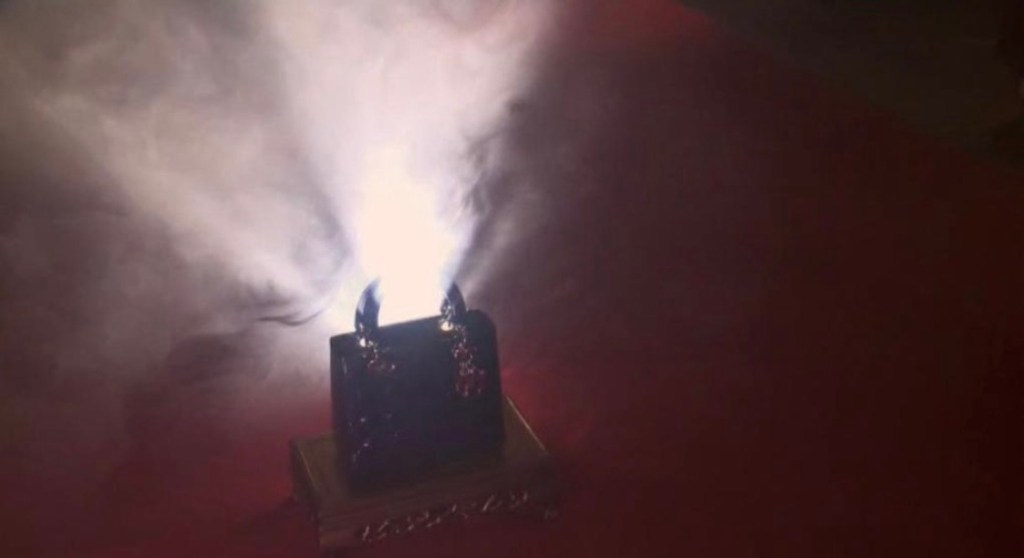
When the woman stops the recording, an extraordinary event occurs. Light erupts, smoke fills the room and a blue Lady Dior handbag appears. The scene reverses the conventions of luxury advertising. Ordinarily, the product is presented as desirable because of its craftsmanship, exclusivity or association with celebrity. Here, the object is frightening because its origin cannot be explained. Its value is no longer simply economic: it appears to carry an emotional and metaphysical charge.
Marx’s (1867/1976) concept of commodity fetishism offers one interpretive framework. In capitalist exchange, commodities appear to possess independent powers while the social relations underlying their production become obscured.
Lynch literalises this process. The handbag appears animated by a force beyond its material construction. Yet the film does not merely criticise consumer desire. It also recognises the capacity of objects to preserve intimate associations. A handbag can contain photographs, letters and souvenirs; here it becomes a container for the memory of a relationship that may never have existed in ordinary time.
Berra (2012) suggests that the film’s dual status as a Lynch production and a Dior campaign is essential. The director’s cinematic identity lends the commodity cultural prestige, while the product supplies the material centre of the narrative. The commercial transaction is transformed into an encounter with mystery.
Figure 2. The supernatural handbag: a luxury object appears as an apparition.
4. The blue rose: Impossible love and cinematic mythology
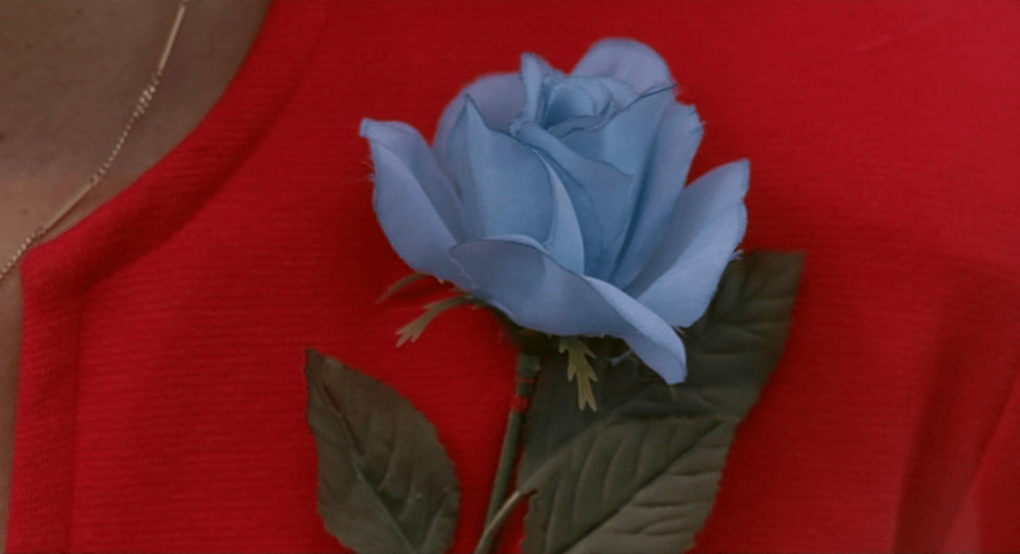
The blue rose is the film’s most concentrated symbolic image. Its unusual colour suggests an object belonging to artifice, fantasy and the impossible. Within Lynch’s mythology, the blue rose already possesses associations with unexplained phenomena. In Twin Peaks: Fire Walk with Me (Lynch, 1992), it participates in a symbolic vocabulary surrounding cases that exceed conventional explanation.
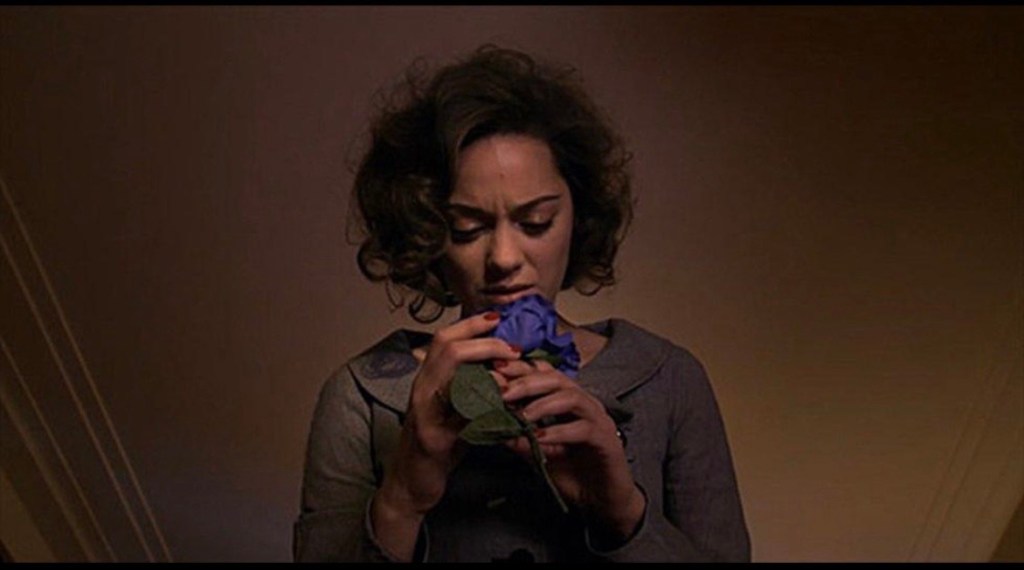
In Lady Blue Shanghai, however, the flower is also a romantic gift. The mysterious lover presents the woman with a blue rose before disappearing. Later, the flower appears inside the handbag, establishing a material connection between the remembered encounter and the present. This is the film’s central paradox: an impossible object becomes evidence of an impossible experience.
The rose belongs to a longer tradition of floral symbolism in European literature and art, in which the unattainable flower can represent longing for a reality beyondeveryday existence. Lynch combines that tradition with the artificial perfection of luxury fashion. The flower is both a token of love and an exquisitely manufactured sign. Its emotional significance depends precisely upon its impossibility.
Figure 3. The blue rose: an impossible flower against crimson.
5. Shanghai: The city as palimpsest
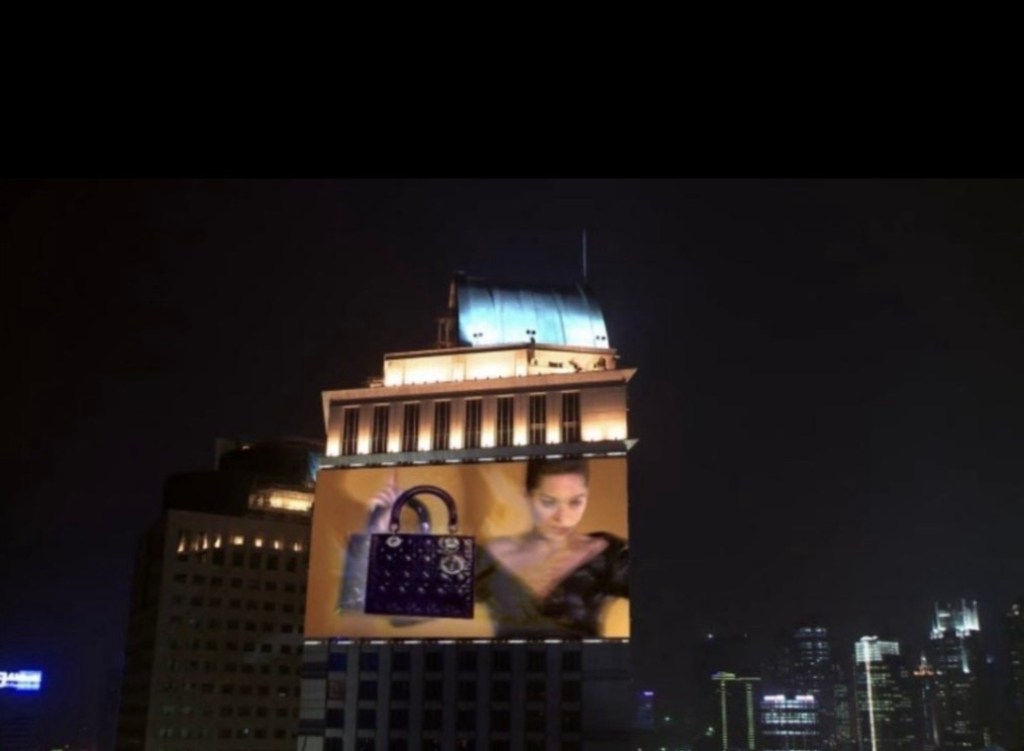
Shanghai is not simply a picturesque backdrop. Its architectural contrasts become fundamental to the film’s representation of time. The film juxtaposes the futuristic skyline of Pudong with interiors and streets suggestive of the city’s earlier cosmopolitan history. Studies of Shanghai’s screen geography describe the city as an assemblage of overlapping historical and commercial identities (Berra, 2014).
During the nineteenth and twentieth centuries, Shanghai developed through complex relationships involving Chinese sovereignty, foreign concessions, international commerce, migration and political upheaval. Its urban landscape consequently accumulated architectural forms associated with different systems of power and cultural identity. The Bund’s monumental commercial buildings, former French Concession streets and contemporary Pudong towers do not represent one continuous historical narrative. They embody successive and sometimes conflicting visions of the city.
Lynch exploits this discontinuity. The woman’s experience suggests that a previous Shanghai persists beneath the visible surface of the present. The city becomes a palimpsest: a surface on which new histories are written without completely erasing earlier inscriptions. The film invites consideration of displaced communities, including Russian émigrés and Jewish refugees, whose cultural lives unfolded through hotels, theatres, cafés and ballrooms. These histories are not explicitly narrated by Lynch; the connection is an interpretive reading, not a claim about his stated intentions. Nevertheless, the film’s vanished identities resonate with broader histories of exile. Shanghai appears as a place where the past survives through fragments rather than continuous recollection.
Figure 4. Shanghai illuminated: the skyline and commercial spectacle.
6. The vanished lover: Romance beyond chronological time
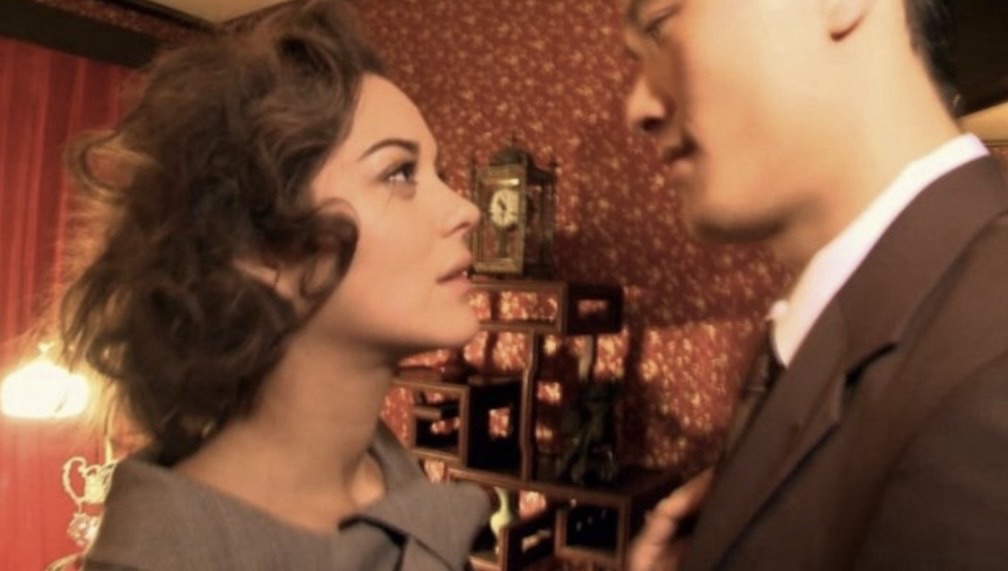
The emotional centre emerges through the woman’s recollection of a mysterious man.
Their relationship appears both immediate and strangely familiar. The encounter unfolds through discontinuous images rather than a conventionally established romance. The film offers insufficient evidence to determine whether it is a supernatural visitation, a repressed memory, a dream or a fantasy.
This ambiguity is consistent with Lynch’s treatment of identity in Mulholland Driveand Lost Highway. In these films desire does not simply motivate narrative action; it reorganises reality itself. Žižek (2000), writing about Lost Highway, examines theunstable relationship between fantasy, subjectivity and traumatic experience.
A comparable approach illuminates Lady Blue Shanghai: the lover may be understood as a character with a fully recoverable biography than as the embodiment of anemotional truth.
The woman’s grief is therefore crucial. She mourns not merely the disappearance of a man but the disappearance of a world in which their relationship could exist. Her tears transform the film from a supernatural puzzle into an elegy.
Figure 5. The lovers: intimacy in the red interior.
7. Sound: Tango, memory and the return of the past
Sound is essential to the film’s emotional and temporal architecture. The antique tango recording ‘Tango Fate’ evokes an earlier period of popular music and ballroom culture. The tango carries associations of desire, separation and choreographed intimacy. Its rhythm suggests bodies moving together while remaining governed by formal patterns. Within the film, the music functions as an auditory relic, arriving before the woman understands the event about to unfold.
This reverses the ordinary relationship between sound and memory: the sound arrives first, summoning a past whose existence has not yet been established. The atmospheric score associated with Lynch and Dean Hurley introduces another sonic dimension. Sustained tones and abrupt changes in intensity create uncertainty about the boundary between music and environmental sound. Chion’s (1995) account of Lynch’s cinema helps explain how sound can establish an unseen force without supplying a visible cause.
The tango belongs to a recognisable historical register, while the electronic atmosphere suggests a reality that cannot be placed in chronological time. Their interaction produces the sensation of temporal haunting. The film’s emotional structure is thus musical as much as narrative.
8. Digital cinema and the instability of the image
The visual texture of Lady Blue Shanghai differs from the polished surfaces commonly associated with luxury advertising. Lynch employs abrupt lighting changes, conspicuous digital effects, distorted movement and composited imagery.
Kasman (2011) associates the film with the experimental digital aesthetic of INLAND EMPIRE. Rather than concealing the instability of digital imagery, Lynch uses it to intensify uncertainty.
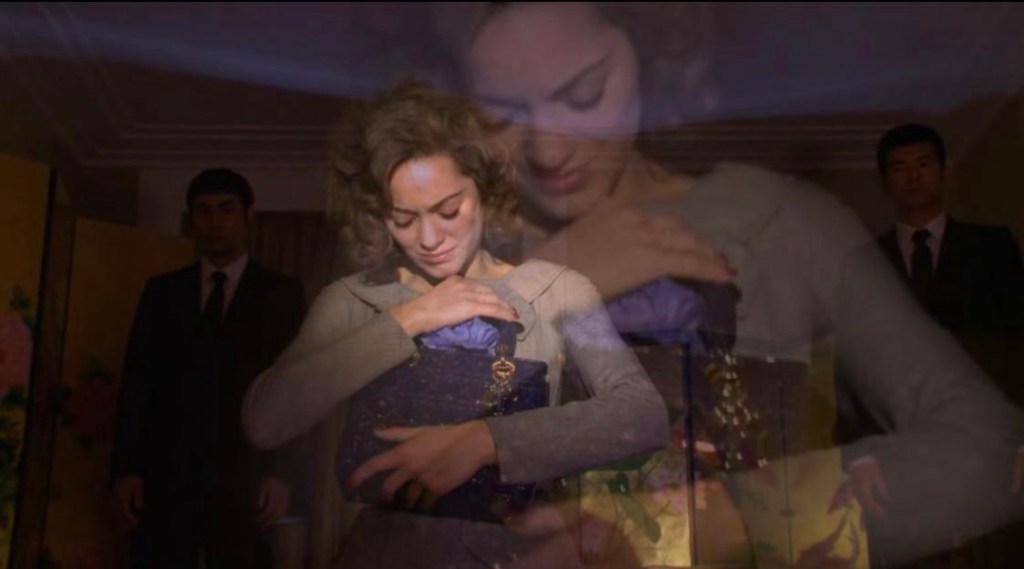
The image may appear simultaneously to record an event and reveal the process through which that event is constructed. Jerslev (2012), examining INLAND EMPIRE, describes fragmentation of cinematic space and time through multiple screens, unstable perspectives and digitally mediated images. This framework illuminates the superimpositions in Lady Blue Shanghai. The woman’s body and the handbag occupy overlapping planes, as though neither can be separated from the other.
Her emotional experience becomes an image projected onto the commodity. The visual language resists a clean distinction between internal psychological states and external material objects. What is remembered becomes visible; what is visible may be remembered rather than real. Lynch’s digital cinema does not merely represent uncertainty. It makes uncertainty a property of the image.
Figure 6. Superimposition: the woman and handbag in overlapping visual registers.
9. The female subject and the luxury gaze
Cotillard’s performance anchors the experimental structure. Her character begins as a recognisably modern professional woman, dressed in a carefully tailored grey ensemble. Her controlled appearance suggests confidence, mobility and participationin an international commercial world. Yet the supernatural encounter progressively dismantles this composure. She becomes frightened, confused and emotionally exposed.
Fashion campaigns frequently construct women as objects of visual admiration.
Lynch instead foregrounds Cotillard’s uncertainty and interior emotional life. The camera studies hesitation, disbelief and grief. Nevertheless, the film does not escape commercial representation: Cotillard’s celebrity, costume and association with Dior remain central to its appeal.
The work therefore operates within a productive contradiction. It grants itsprotagonist psychological complexity while incorporating that complexity into themythology of a luxury product. The woman’s experience is moving, but the handbagremains the object through which that experience is ultimately organised.
10. Auteur cinema and the fashion-film economy
The commissioning of Lady Blue Shanghai belongs to a broader transformation inluxury marketing during the early digital era. Fashion houses increasingly collaborated with established filmmakers to create online works that could circulateas entertainment rather than conventional advertisements. Dior’s Lady Diorcampaign included films by several directors, each bringing a recognisablevocabulary to the brand.
Lynch’s contribution refuses the clarity normally associated with promotionalstorytelling. The handbag is visible, but its desirability is inseparable from fear,longing and loss. Todd (2012) examines the significance of authorship and aestheticidentity in Lynch’s career; his approach helps explain how a commercial commissioncan function as identifiable auteur cinema.
The red interiors, supernatural objects, unstable identities and enigmatic soundscape make this work unmistakably Lynchian. Yet authorship is not equivalent to complete independence. The commission required a product and a place. Berra (2012) treats the resulting dual identity as fundamental rather than incidental. The film does not resolve the tension between art and commerce: it aestheticises that tension.
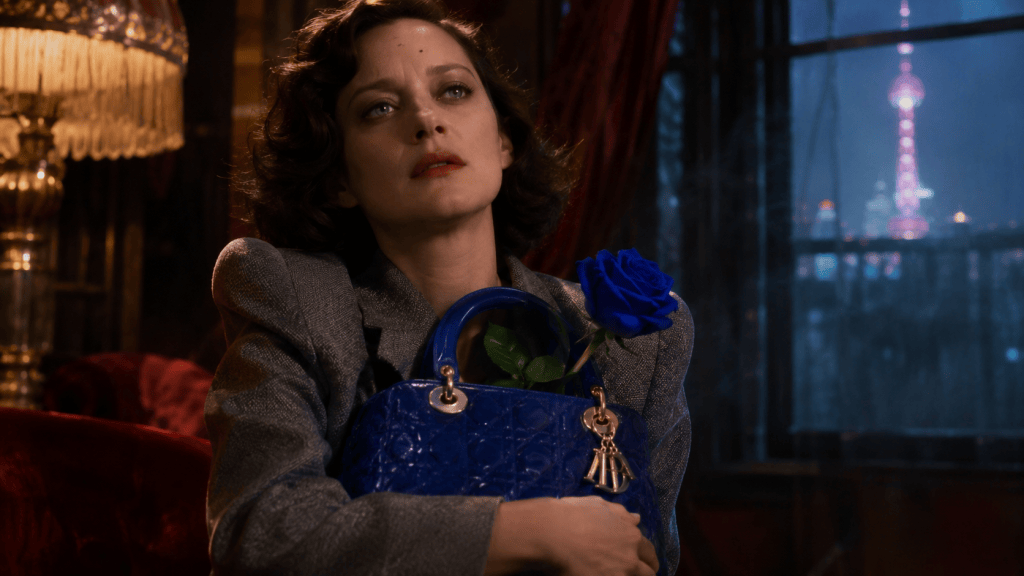
The film concludes with the woman holding the handbag against her body. The gesture resembles an embrace. She holds the bag as though holding the absent lover.
The substitution is emotionally unsettling: the object survives, but the person does not. The commodity becomes a substitute for human presence.
The ending can be read as a critique of consumer culture, in which objects promise to compensate for irrecoverable experiences. Yet such an interpretation would be incomplete. Objects genuinely preserve memories. A photograph, garment, letter or inherited possession may acquire significance through association with someone Lynch exploits this human tendency without offering a simple moral judgement.
The handbag is simultaneously a luxury commodity, an impossible apparition and a vessel of mourning. The blue rose establishes that the remembered relationship cannot simply be dismissed as fantasy, but it does not supply an objective explanation. The mystery remains open.
Figure 7. The final rose: the physical relic of a vanished relationship.
12. Conclusion: The persistence of longing
Lady Blue Shanghai demonstrates how a commercial film can become a sophisticated exploration of cinematic memory. Its narrative is minimal, but its symbolic architecture is unusually dense. The hotel becomes a threshold between realities. The gramophone summons a vanished historical moment. The handbag materialises without explanation. The lover appears across an uncertain temporal divide. The blue rose survives as evidence of an impossible encounter.
Shanghai intensifies these themes through the juxtaposition of historical architecture and contemporary transformation. The city is not presented as a documentary account of its past. It becomes an imaginative geography in which different historical moments appear capable of occupying the same space. This is suggestive when read against Shanghai’s histories of migration, exile and cultural displacement.
The film’s achievement lies in transforming luxury advertising into an elegy for absence. Dior’s handbag is intended to be desired and possessed. Lynch makes it the container of something that cannot be possessed: an irrecoverable experience of love.
The blue rose is the emblem of this contradiction: artificial yet emotionally authentic,impossible yet materially present, beautiful yet inseparable from loss. In Lynch’sShanghai, the past does not disappear. It waits behind a hotel door, plays upon anantique gramophone and blooms once more as a blue rose.
References
Berra, J. (2012) ‘Lady Blue Shanghai: The strange case of David Lynch and Dior’, Film,
Fashion & Consumption, 1(3), pp. 233–250. https://doi.org/10.1386/ffc.1.3.233_1.
Berra, J. (ed.) (2014) World Film Locations: Shanghai. Bristol: Intellect.
Chion, M. (1995) David Lynch. London: British Film Institute.
Freud, S. (1919/1955) ‘The uncanny’, in Strachey, J. (ed. and trans.) The Standard
Edition of the Complete Psychological Works of Sigmund Freud, Vol. XVII. London:
Hogarth Press, pp. 217–256.
Jerslev, A. (2012) ‘The post-perspectival: Screens and time in David Lynch’s Inland
Empire’, Journal of Aesthetics & Culture, 4(1). https://doi.org/10.3402/jac.v4i0.17298.
Kasman, D. (2011) ‘Video of the day: David Lynch’s Lady Blue Shanghai (2010)’, MUBI
Notebook. https://mubi.com/en/notebook/posts/video-of-the-day-david-lynchs-lady-blue-shanghai-2010 (Accessed: 15 November 2026).
Marx, K. (1976) Capital: A Critique of Political Economy, Volume One. Translated by B.
Fowkes. Harmondsworth: Penguin. (Original work published 1867.)
Todd, A. (2012) Authorship and the Films of David Lynch: Aesthetic Receptions in
Contemporary Hollywood. London: I.B. Tauris.
Žižek, S. (2000) The Art of the Ridiculous Sublime: On David Lynch’s Lost Highway.
Seattle: University of Washington Press.
Vanity Fair (2010) ‘Dior’s Lady Blue Shanghai, Chapter 3’.
Accessed: 15 November 2026).
Filmography
Kubrick, S. (dir.) (1980) The Shining [Film]. Warner Bros.
Lynch, D. (dir.) (1986) Blue Velvet [Film]. De Laurentiis Entertainment Group.
Lynch, D. (dir.) (1992) Twin Peaks: Fire Walk with Me [Film]. New Line Cinema/CIBY
2000.
Lynch, D. (dir.) (1997) Lost Highway [Film]. October Films/CIBY 2000.
Lynch, D. (dir.) (2001) Mulholland Drive [Film]. Universal Pictures/StudioCanal.
Lynch, D. (dir.) (2006) INLAND EMPIRE [Film]. StudioCanal and associated companies.
Lynch, D. (dir.) (2010) Lady Blue Shanghai [Short film]. Christian Dior.
Illustration credits
Figures 1–7: screenshots supplied by the user, from Lady Blue Shanghai (2010),
directed by David Lynch. © Christian Dior and respective rights holders. Used for critical commentary. Figure numbering follows placement in this illustrated edition.

