
Asia Shanghai
Chapter One: Asia Shanghai
“Shanghai. A heaven built upon a hell!”
Mu Shiying, “Shanghai Fox-trot” (1934), p. 105
Translated by Andrew David Field and Hong Yu, Mu Shiying: China’s Lost Modernist (2014)
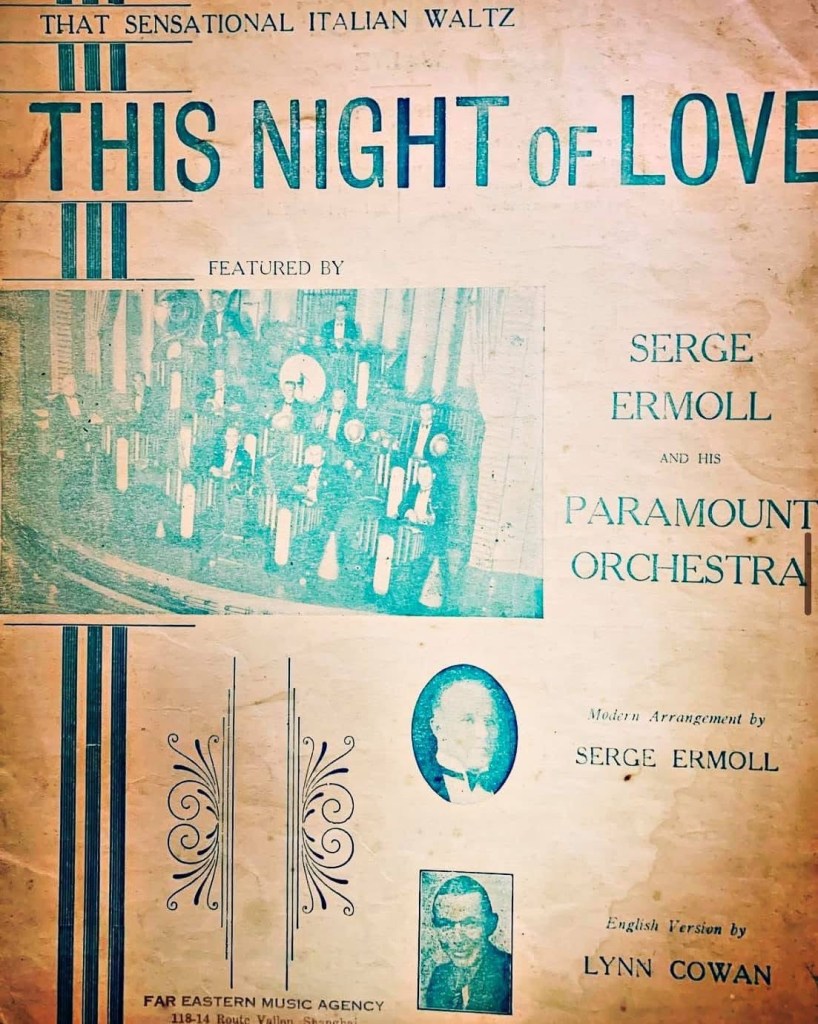
Serge Ermoll and His Music Masters. Paramount publicity section.
The light is coming through my shoes. I look down to be certain: green, then rose, then a blue so deep I think I might fall into it. The glass holds. Somewhere beneath us there must be another room, another sky. Smokey takes my hand and we run before anyone remembers that the floor belongs to the grown-ups.
Uncle Serge is lifting his arm.
I know what comes next, though I cannot name the tune. A man brings the brass to his mouth, another leans into the piano, and the room draws its breath with them. How can so many people know when to begin? At home a question can make everyone talk at once. Here a small movement of my uncle’s hand is enough. I want to learn that movement. I want to be able to ask for something without speaking.
The Paramount smells of polish and flowers with warm water in their stems. White and silver everywhere. My mother is somewhere upstairs; Aunt Xenia is close enough that I need not look for her. My father is away, away is the word that takes up his chair. Serge stands beneath the lights and the music goes on making a place for us.
Smokey’s father writes music. Rudolf Friml: the name is too large for the boy who runs beside me. I know his shoes, the quickness of his laugh, the trouble we can find between one corridor and the next. We dance at tea time, while cups move above their saucers and the adults have not yet become the people they will be tonight.
In the morning the dancers practise. The same woman goes back to the same spot and tries again. I watch her shoulders. I turn when she turns. My feet are late, then less late. She is not smiling now, and I like this face too, the face that is busy making the other one possible. A step belongs to anyone patient enough to follow it. Perhaps I can follow it all the way into the evening.
Outside, my amah leads me through the lanterns. The street offers its own small invitations: something sweet, something hot, a taste that stains my mouth and must be wiped away before we reach home. Her thumb moves firmly across my lips. I resist because I want to keep the colour.
Other hands are working around us: carrying, cleaning, pulling a rickshaw through the dark. Behind the ballroom doors someone is putting every chair back in its place. I can run because someone is watching me. I can dance because someone has made the floor.
The lantern rocks. Under the glass, the light changes again. I lift one foot and then the other, testing how much brightness a child can carry.
Chapter Two: Xenia in the Photograph
“Recently she had become intrigued by the admiring glances of other women. … Together, women formed a conspiracy of glances …”
J. G. Ballard, The Kindness of Women (1991), abridged excerpt
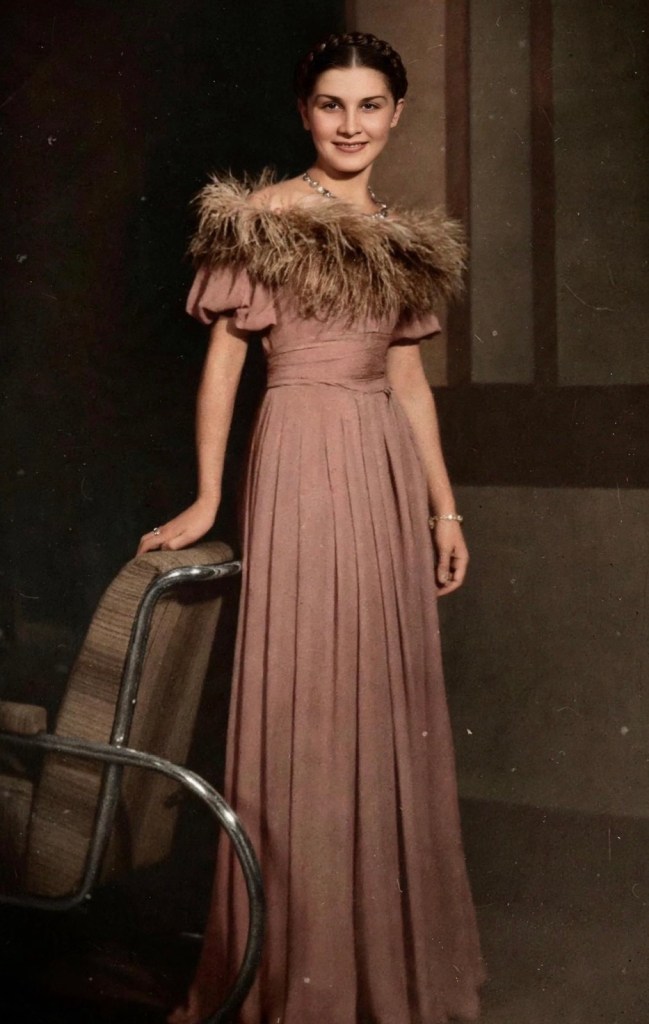
Xenia Vladimirovna Ermolaeff, Shanghai, identified as 1935. Attributed to Josepho Studio; supplied colourised version.
Aunt Xenia does not move when I look away.
She is standing beside a chair, one hand resting upon it, her dress falling in a long, quiet line. The feathers around her shoulders seem about to stir. Her mouth holds the beginning of a smile. I know that mouth outside the photograph, opening to speak, closing when she is listening. Here it waits for me.
Josepho. Shanghai. The name of the studio seems to promise that a person can be kept somewhere other than the rooms in which she lives. I look at the ring. A little light is lodged in it. How long must she have held her hand like that? My own fingers begin to twitch merely thinking of it. I want to touch the chair and feel whether the arm is as cool as it looks.
Her sisters belong to one another in ways I am still learning. My mother’s voice changes when she speaks of them. Sometimes I hear the girl inside her, the one who has not yet become my mother, who has sisters and an earlier house and reasons for laughing that have nothing to do with me. Xenia knows that girl. She can reach her without passing through the rooms where I get everything wrong.
I stand before the photograph and try the angle of her shoulders. Not quite. My chin is too high. When I lower it I feel myself becoming solemn, which is not the same thing as being composed. Xenia seems comfortable inside her own outline. I keep shifting within mine.
The dress is beautiful, but it is her hand I return to. A hand can make a child welcome without any ceremony. It can adjust a sleeve, draw a chair nearer, rest for a moment on the back of a neck. I do not need to be the centre of the room. I need to know there is somewhere in it where I can stay.
Serge’s name is spoken with the names of hotels and orchestras. Xenia’s comes to me through people. My aunt. My mother’s sister. A woman beside a chair, with a light on her hand. I am afraid that if I look only at the beautiful dress I will miss what makes her familiar.
How strange that the photograph can show so much and never tell me whether she is tired. The feathers remain still. Somewhere outside this small rectangle she is walking, turning a key, listening to someone finish a story. I want that moment too, the one after she is allowed to move.
For now I practise standing. My hand settles on a chair. I let my shoulders lower, and there is a little more room in me.
Chapter Three: Serge and the Invisible Audience
“Time and timing. Grace and desire.”
Brian Castro, Shanghai Dancing (2003)
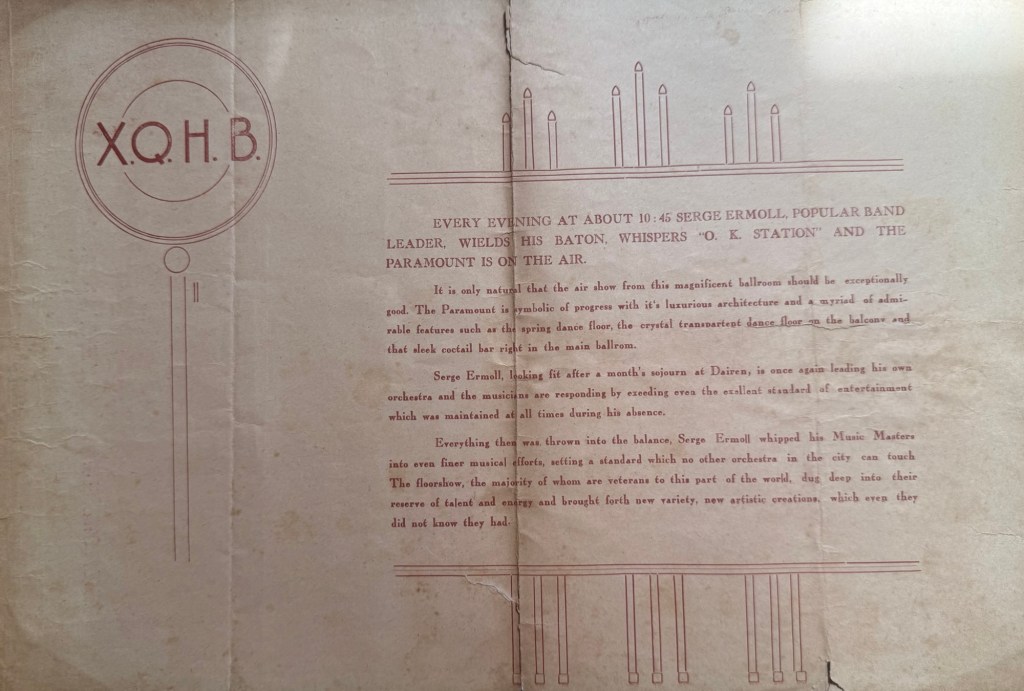
XQHB and the Paramount broadcast. Undated Serge Ermoll publicity booklet.
Ten forty-five. I hold the numbers in my mouth as if they are the name of a place.
The room is full, but Uncle Serge seems to be listening beyond it. A musician shifts his page. There is a small waiting inside the larger noise, a space the glasses and voices cannot quite fill. Then the words: “O. K. Station.”
The Paramount is on the air.
I try to imagine where the music goes. Out through the walls? Up past the windows? Does it pass the river without getting wet? Somewhere a hand turns a dial and my uncle enters a room he has never seen. The dancers here must share him with someone sitting alone, someone who is ill, someone whose supper is growing cold because the tune has begun.
XQHB. The letters look like a secret that everyone is allowed to know.
The microphone does not need the coloured floor. It cannot carry the satin or the little shine at the bottom of a glass. Yet it takes the sound of the room, perhaps even the distance between two people who have stopped speaking. I stand very still, as if it might hear me thinking. If I move my foot, will a stranger know?
Nick Volkoff. Bob Sherman. Glieb Smirnoff. Tony Kainz. Herman Barten. George Pogibin. The names gather around Serge, men with faces and particular ways of waiting. I know some by the music they make and some by the way they fold themselves into a chair. The orchestra is called his, but the tune passes through all of them before it reaches us.
Pathé and Columbia are other names, names that can be printed on a record. A record can begin again. I like this about it. The needle finds the place and the voice returns, obedient to a small circle. The radio is less reassuring. Music arrives and is already leaving. I want someone to catch it before it goes.
Buck Clayton belongs to another bright corner of my mind: the kindness of a musician near a child, the pleasure of being noticed. Shanghai holds more bands than I can count, more rooms than I can enter. Their sounds reach one another through open doors. I cannot draw the boundaries the grown-ups seem to need.
Serge gives the entrance. Nothing is hurried, although everyone must be ready. I feel the discipline of the instant, the breath before the first note, and understand it with my body before I can explain it.
Somewhere the listener has found the station. I send the music towards that person. I do not know how to say hello over such a distance. My uncle already does.
Chapter Four: An Address for the Music
“Wake up, Shanghai! Shanghai, a heaven built upon a hell!”
Mu Shiying, “Shanghai Fox-trot” (1934), p. 118
Translated by Andrew David Field and Hong Yu, Mu Shiying: China’s Lost Modernist (2014)
R. T. Hamilton and Hamilton-Mills Theatrical and Vaudeville Enterprises. Undated publicity spread.
Hamilton House. The words stand straight on the page, a building made out of a name.
R. T. Hamilton looks to one side, as if someone has just come into the room. Beneath him is Uncle Serge’s name, and the Music Masters. Representing. I turn the word over. It means someone can speak for you while you are elsewhere, playing, travelling, asleep. There is a part of the music that happens in offices.
Hamilton-Mills. Theatrical and Vaudeville Enterprises. The letters have the confidence of adults who know where to send a letter and what to put inside it. I follow the list with my finger. Shanghai first: the Cathay Hotels, the Paramount, Park Hotel, Little Club, China Broadcast, French Club, Country Club. Then Tientsin. The Country Club and Forum Ballroom. Colombo, Galle Face Hotel. Saigon, Continental Palace Hotel.
The names make the sea seem smaller.
I do not know whether Serge has stood in every room. A list is not a journey. Still, I can feel the journeys waiting inside it: a case closed, a timetable consulted, someone counting the money twice. A musician must arrive before the evening can become effortless. Perhaps an orchestra has another rhythm, made of trains and letters and the days between engagements.
Now the Lido. Medhurst Road, number 306, off Avenue Road. I like the certainty of a number. It tells the rickshaw where to stop. Inside, the stage opens in shining curves, one arc within another, as if the music has begun before anyone touches an instrument. The stands face us. The men wait behind them. Serge is in front.
Sunday tea dance, five to eight. One dollar including tea. Three hours can be bought and made into an afternoon a person remembers for years. A cup, a tune, a hand at the waist. The advertisement cannot say which of these will stay.
The grown-ups talk about a new ballroom as though the city has acquired a new organ. Blue light, green rooms, mirrors, a bar at the back. The Lido is ready to receive everyone’s hopes for the evening. Underneath the praise I hear quieter questions. Who will play? How much? Until when?
Serge is the former Paramount maestro. Former: a little door closing inside a word. The music does not stop at the door. It moves with him to another stand, another room that must learn how his hand rises.
I trace the cities again. Shanghai, Tientsin, Colombo, Saigon. I am still here, with my finger on a page, but the paper has begun to feel like a ticket. Somewhere a room is being prepared. Someone is expecting the band.
Chapter Five: The French Club and the Cold Studio
“Through the window was the pagoda at Lunghua Airfield. Already the flak tower appeared in a new light.”
J. G. Ballard, Empire of the Sun (1984)

The Danilevsky Sisters. V. D. Zhiganov, Russians in Shanghai (1936). Contextual image of Shanghai’s émigré ballet world.
Water presses gently against my ears. When I go under, the voices at the pool become a faraway argument I need not answer.
The French Club is immense. Cercle Sportif Français: I can say the whole name, but swimming is the word I want. If I behave, I may go. I try to discover what behaving means by watching my mother’s face. Sometimes I find the answer too late. In the water there is a simpler arrangement. Kick and I move. Hold my breath and I can remain beneath the surface until the bright trembling above me becomes irresistible.
Uncle Serge knows the club at another hour. I picture the wet floor dried, the voices dressed for evening, music spreading into places where there has been only the slap of water. We belong to the same building without inhabiting the same day.
At home the piano begins again. My mother’s friends arrive on Sundays and the afternoon lengthens past all its proper edges. There are singers, dancers, people who write, people who cannot finish an argument because a phrase has taken hold of them. I sit quietly. If I am quiet enough, I can stay. The room fills with things I am hungry to learn.
Now the windows are covered. Now the radiators are gone.
The cold finds every space the music leaves. There is less food, less money, less certainty about tomorrow. The amah stays. I hear that she is not being paid, and cannot make this fit the steadiness with which she goes on caring for us. Outside, soldiers stand where yesterday there is a street. The club is no longer ours to enter as we please.
At the barre I cannot feel my fingers properly. My feet swell. The shoes must come off slowly, warm water first, patience, someone’s hands helping. I look away and then look back because these are my feet and I will need them again.
Canvas. Glue. Ribbon saved from another pair. I take the old shoes apart to learn their shape. There must be a way to make the next ones. The pleasure of the floor now depends on what I can fashion at a table. I press the material into place and wait for it to hold.
Komaki brings cream puffs. For a moment there is that astonishing softness, the taste of something generous in a world that measures everything. Ballet can continue. I take the sweetness and the possibility together, too young to understand all the arrangements that allow either one to reach us.
Serge notices that I am growing up. I carry his recognition carefully, afraid of losing it on the way home. A young woman: perhaps the person he sees is already waiting somewhere inside me.
I put on the shoes. The floor is cold. I begin.
Chapter Six: The Work After Applause
“Everything might scatter. You might be right.”
Kazuo Ishiguro, When We Were Orphans (2000)
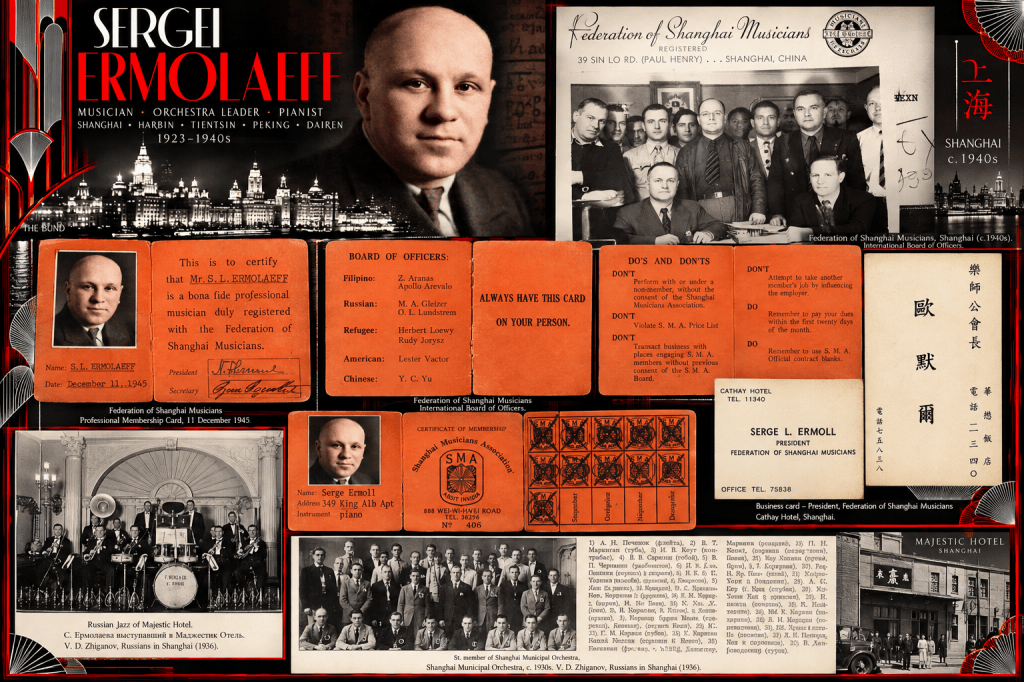
Federation of Shanghai Musicians membership card, 11 December 1945. Detail from the supplied reconstructed archival panel.
Eleven December 1945. The numbers lie below Serge’s photograph, neat and dark.
S. L. Ermolaeff. My uncle, with another arrangement of letters around the face I know. A bona fide professional musician, registered with the Federation of Shanghai Musicians. I read the words slowly. They sound solemn, almost like a promise someone else is making about him.
There are rules about dues, contracts, prices, employers. I used to think the evening ended when the last dancers left. But here it continues in a payment, a signature, a date that must be remembered. The men put away their instruments and still need to eat. An orchestra cannot live on the sound it makes.
The card can be carried in a pocket. I like the thought of all that certainty folded small: this man belongs to his profession, this face has a name, there is somewhere to take a disagreement. The city has been so good at making people wait, at asking them to explain who they are. A card cannot answer every question. It can answer one.
The war is over. The phrase goes from mouth to mouth, and I try to make it enter the house.
I swim again. I meet people who do not know the frightened versions of me, who have not been present for every mistake. Among them my voice comes more easily. Then I return home and feel it grow careful. Peace can arrive in the streets before it reaches a family. I listen for the change in my mother’s mood as another person might listen for rain.
Serge goes on working. Cathay: the name lifts a tower in my mind. Music high above the Bund, music for officers, the Silk Hat, a smaller group finding its place in the immense work of evenings. His business card calls him president of the Federation. I think of all the musicians he must hear when they are not playing, the worries that have no melody.
Aunt Xenia moves through these days too. I want to ask what she thinks when another engagement is settled, when the news arrives, when the house is finally quiet. I know her composure and mistake it, sometimes, for the absence of fear. Then a small movement of her hand reminds me that other people have rooms inside them to which I have no key.
There is another evening to prepare for. A clean shirt, an address, a part that must be taken along. I keep looking at the photograph on the card. The public face of a man who is my uncle. The hand that lifts the band into motion belongs to someone who must be ready to work tomorrow.
I fold the paper carefully. Nothing should be lost merely because it is small.
Chapter Seven: The Chandelier Room
“I have a secret to tell you. Will you leave with me?”
Wong Kar-wai, 2046 (2004), English subtitle wording
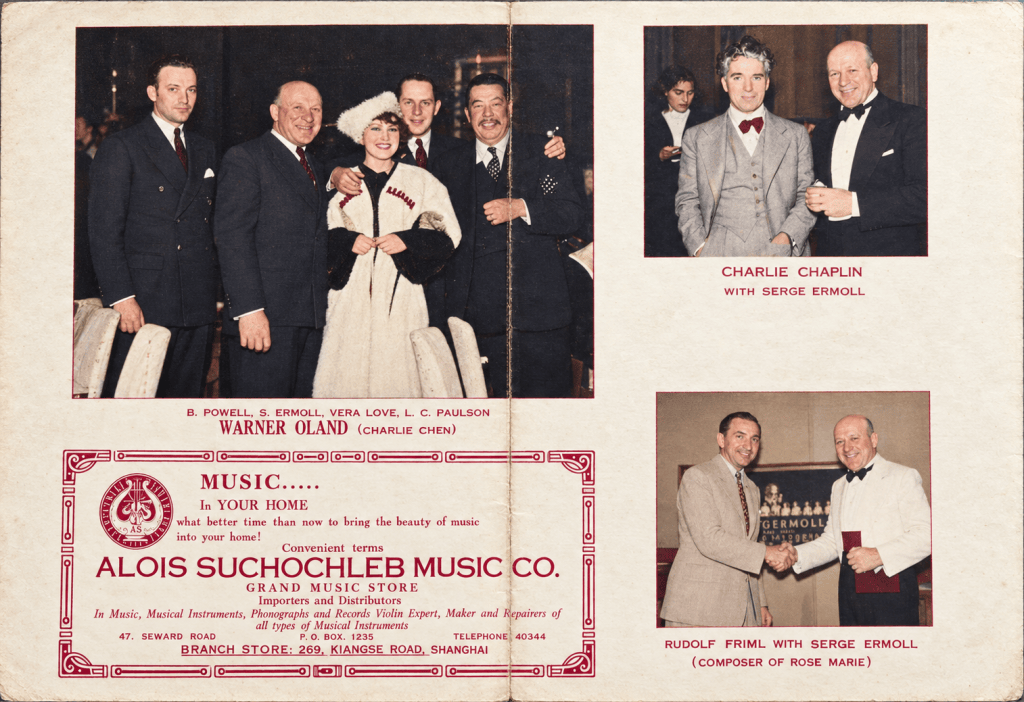
B. Powell, S. Ermoll, Vera Love, L. C. Paulson and Warner Oland, as captioned in the booklet. Undated. Contextual social photograph, not Asia’s wedding.
The pearls are being sewn into the dress. I can feel their little weight before I am wearing them.
Marty is American. He makes me laugh, and laughter is a door I have almost forgotten how to open. He works in a bank; he seems to know how a future can be arranged. I am agreeing to marry him. I listen to myself agreeing, as though someone nearby is speaking in my voice.
Tell Mother. Let her stop me. Let her say I am too young, that there is time, that I need not leave her in order to become someone.
The refusal does not come.
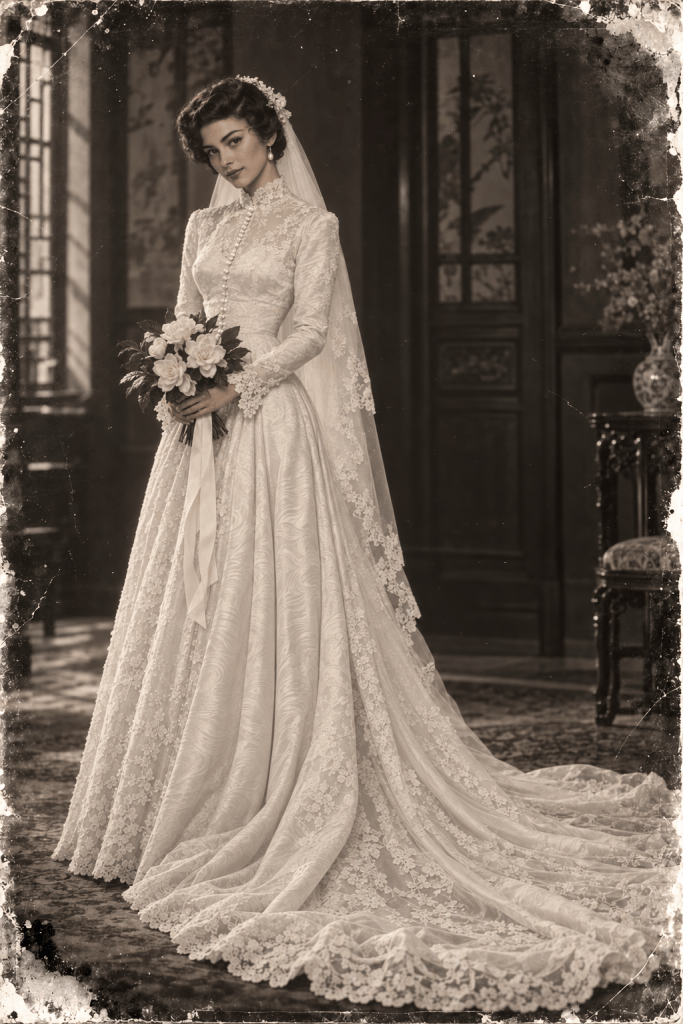
White French moiré. Long sleeves, a high neck, a train. Chantilly lace follows me when I move. I look down and see the work of hands I scarcely know, the minute stitches that make this enormous decision presentable. Six hundred invitations. Five hundred and fifty people expected. There must be enough happiness for all of them. I try to find where it is kept.
At church the amah is crying. I want to go to her, but the dress has a direction of its own, and everyone knows where I am supposed to stand. Her tears make me feel the child inside the bride. I have not managed to leave that child behind. She is coming with me in the white shoes.
Cathay Mansions, across from the French Club. The chandeliers seem to multiply the room. Champagne moves among the guests. Faces turn towards me, and I smile until the muscles at the corners of my mouth begin to tremble. I can be seen from everywhere. I am not certain where to put myself.
The music reaches me through the voices. I do not look for the bandstand. Somewhere underneath this evening is another one: Serge raising his hand, the glass floor glowing, Smokey beside me before either of us knows what a promise can cost. The child knows how to dance into a room. The bride must learn how to leave it.
Xenia’s face comes to me, the calm of the photograph. I borrow that calm for a breath, then another. Nobody needs to know how carefully I am balancing.
Afterwards the expected future falters. There is a pregnancy, then there is not. There is illness and a room in which other people are watching me breathe. I return slowly to the ordinary work of being alive. Water in a glass. Light arriving at the window. My own hand lifted without assistance.
Outside, Shanghai is full of departures being discussed before anyone packs. The wedding guests have gone home. The lace is folded. I am learning that a life can change its size without warning: first a room crowded with hundreds of people, then a bed, then the space inside a suitcase.
I lay one thing beside another. This can come. This must stay.
Chapter Eight: America Beyond the Dial
“Take care. Maybe one day you’ll escape your past.”
Wong Kar-wai, 2046 (2004), English subtitle wording
Serge Ermoll, portrait accompanying His Story. Undated publicity booklet.
The engine will not leave my ears.
It is 1949, and I am above the sea. Northwest Airlines. The words are printed and certain; everything beyond the window seems without an address. Marty is not beside me. His family will meet me in New York. I repeat this to myself, giving each part of the sentence time to become true.
Japan. The Aleutians. Canada. Chicago. The places arrive as names before I see them, and leave as names when the plane begins again. Forty-eight hours, or perhaps one long hour that keeps folding itself into another. I cannot tell whether I am hungry or tired. The seat is a small country I have been assigned to inhabit until someone opens a door.
When I close my eyes, the ballroom lights move beneath me. I am travelling over water and standing on glass. Both are true inside my body.
Serge is still in Shanghai. Xenia is still there. My departure has not taken the city with it, though the city is occupying so much of my luggage that there is scarcely room for the things I can unfold. My amah’s hands. The cold barre. Glue drying on canvas. The taste of a cream puff when sweetness seems almost impossible. I have packed none of these. They are here.
At Idlewild the sky is red. The propellers stop, but their turning continues somewhere behind my face. People are coming towards me with kindness. I must recognise them, answer, be grateful, know where to go. My feet touch a floor that does not move. For a moment this is bewildering.
Jersey City. A couch to sleep on. Rooms joined one behind another, the household passing through them in its accustomed way. I am welcomed, and still I lie awake. The old measure of distance is useless here. Shanghai can be on the other side of an ocean and close enough to hear through the wall.
Then the ballet studio.
I stand where I am asked to stand. The body remembers its work. There are teachers, mirrors, other dancers, a discipline whose language I can follow before anyone learns much about me. Here a movement can answer a question. I begin, and the cold Shanghai room is suddenly helping me in America.
Asia. My name is called. I take the place it opens.
The engine quiets a little. In its place I hear a breath, the breath before the entrance. Serge is lifting his arm somewhere in the city I cannot reach. A musician looks up. The room waits. I am far away, and the waiting is familiar.
The tune begins. I move.
Epigraph sources
Brian Castro, Shanghai Dancing. Giramondo, 2003. Opening extract reproduced at Strange Black Box: https://strangeblackbox.net/virtual-archive-of-cultural-memories-slow-boat-to-china/
Kazuo Ishiguro, When We Were Orphans. 2000. Chapter Six quotation: https://www.goodreads.com/work/quotes/3333606-when-we-were-orphans
J. G. Ballard, Empire of the Sun. 1984. Author extract published by The Guardian, 19 April 2009: https://www.theguardian.com/books/2009/apr/19/jg-ballard-extract-empire-of-the-sun
Wong Kar-wai, 2046. 2004. English dialogue/subtitle quotations reproduced at https://en.wikiquote.org/wiki/2046_(film) . English subtitle wording varies between releases.
Mu Shiying, “Shanghai Fox-trot” (1934), in Mu Shiying: China’s Lost Modernist. New translations and an appreciation by Andrew David Field; co-translator Hong Yu. Hong Kong University Press, 2014, pp. 105 and 118. Publisher: https://hkupress.hku.hk/index.php?product_id=479&route=product/product . Translator’s earlier online version: https://www.shanghai-sojourns.net/blog/2011/3/20/shanghai-fox-trot.html
J. G. Ballard, The Kindness of Women. 1991. Abridged two-sentence excerpt; ellipses indicate omitted wording and an intervening sentence. Quotation source: https://www.goodreads.com/work/quotes/1232082-the-kindness-of-women

